

It’s the question that haunts every person who has ever questioned their relationship with alcohol: “Can I ever get control back?” We lie awake at night, replaying our failures, vowing that tomorrow will be different. We bargain, we set rules, we white-knuckle our way through temptation, all in the name of regaining control.
But what if we’re asking the wrong question? What if the pursuit of control is the very thing keeping us trapped? To find the path to true freedom, we must first be brutally honest with a more fundamental question: Did we ever really have control in the first place?
(The Illusion of Control)
In the beginning, it feels like control. We decide when, where, and how much. We believe the story we tell ourselves: “I’m a social drinker.” “I can take it or leave it.” This is the mirage. Neuroscience shows us that with each drink, we strengthen the very neural pathways that crave the dopamine release alcohol provides. What feels like a choice is slowly becoming a conditioned response—a habit on its way to becoming a compulsion.
We weren’t lying when we said we had control. We were simply in the early stages of a process where the illusion had not yet been shattered by the reality of a changing brain chemistry. The progression often feels like causality—a predictable chain of cause and effect that leads from one drink to a loss of the very control we thought we possessed.
(The Paradox of Powerlessness)
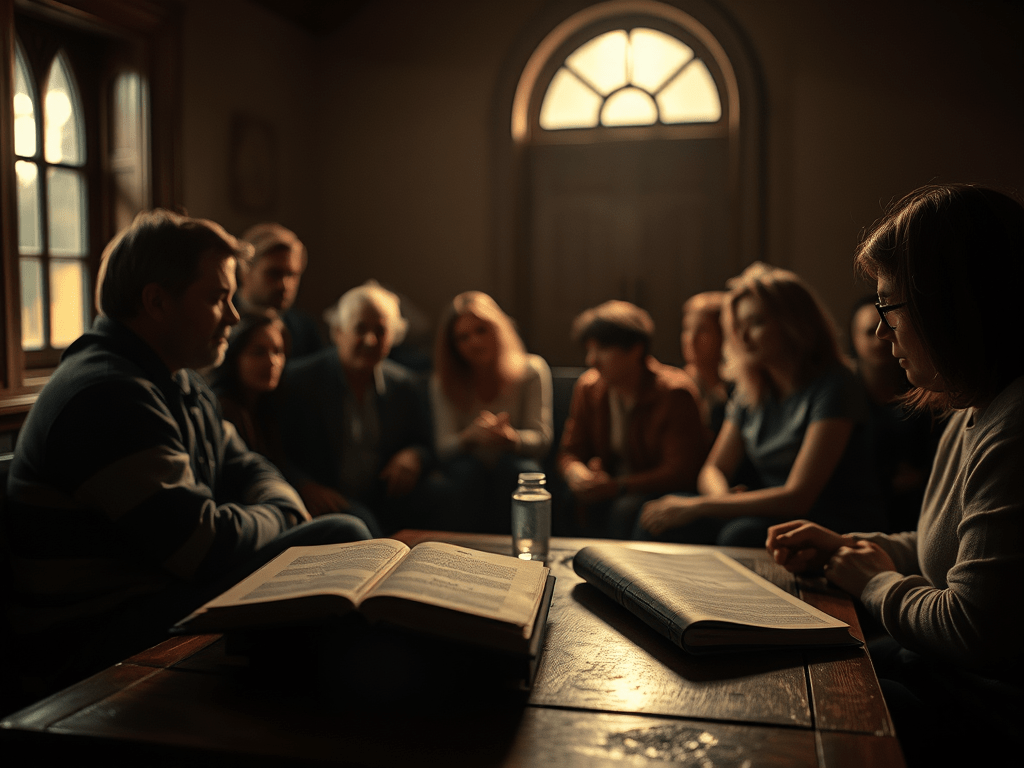
This is where the journey takes a counter-intuitive turn. Our entire culture screams at us to “take control,” to “be stronger.” But the universal testimony of recovery, from the rooms of AA to the pages of Scripture, points us in the opposite direction. Freedom is found not in strength, but in surrender. Not in control, but in confession.
The foundational first step of AA is to admit we are powerless—that our lives have become unmanageable. This isn’t a statement of defeat; it’s the first clear-eyed, honest assessment that breaks the cycle of delusion. It is the necessary death of the illusion.
This truth is echoed powerfully in the Bible:
“But he said to me, ‘My grace is sufficient for you, for my power is made perfect in weakness.’ Therefore I will boast all the more gladly about my weaknesses, so that Christ’s power may rest on me.” – 2 Corinthians 12:9
Our weakness, our powerlessness, is not a barrier to God’s help—it is the prerequisite for it. When we stop trying to be the hero of our own story and admit we need a savior, we finally access a power that is not our own.
(Grace, Not Willpower)
Leaning on our own willpower is like trying to put out a fire with a thimble of water. It’s a finite resource that gets exhausted, especially under the stress and triggers of daily life.
“Trust in the Lord with all your heart and lean not on your own understanding; in all your ways submit to him, and he will make your paths straight.” – Proverbs 3:5-6
This is the divine alternative to the exhausting cycle of self-effort. We are commanded to stop leaning on our own shaky understanding (which includes our belief in our own control) and to trust in a wisdom and strength far greater than our own.
The warnings against drunkenness in Scripture (Ephesians 5:18, Proverbs 20:1) are not arbitrary rules. They are loving guidance about a state that robs us of self-control—a quality the Bible lists as a fruit of the Spirit (Galatians 5:22-23). The “drunkard” is someone who has voluntarily surrendered their God-given self-control to a substance. The path back is to voluntarily surrender it back to God.
(The Truce: A Structure for Surrender)
So, where does this leave someone like me, who seeks a “Grateful Truce” with moderation? My “Math of Moderation” is not an assertion of my own superior control. It is the exact opposite. It is a disciplined structure I choose to put in place precisely because I know my willpower is flawed and my brain’s wiring is prone to old habits.
It is an active practice of surrender. It is me saying, “God, I cannot trust myself to navigate this on feeling alone. So, here is the plan we will follow together. I am surrendering my ambiguity and my pride, and I am asking for your strength to uphold this boundary.”
(Conclusion)
The question is not, “Can I regain control?” The liberating, life-giving question is, “Am I ready to surrender the exhausting pretense of control and finally accept the grace that has been waiting for me all along?”
Freedom from addiction is not found in the grip of our own will, but in the open hands of surrender. It is the journey from the mirage of control to the oasis of grace. It is in our admitted weakness that we find a strength that never, ever fails.
What are your thoughts on control versus surrender? Share your experience in the comments below.
Chris Mosser
Author Grateful Truce & The AGI Dilemma


 Grateful Truce
Leave a comment